|
The Real Thing Is Far Better by Rolaant McKenzie |
|
|
In the Star Trek: The Original Series episode, What Are Little Girls Made Of? (Season 1, Episode 7, 10/20/1966), famed Federation archeologist Roger Korby, accompanied by his long-time assistant Dr. Aaron Brown and Andrea Milton, led an expedition to the third planet of the Exo star system. Korby relayed messages to the Federation until his survey ship crashed on the planet, killing Brown and Milton and severely injuring him. Once a lush, temperate planet, the sun began to dim long ago, turning Exo III into an ice planet. The long-extinct humanoid inhabitants of the planet fled underground to escape the inhospitable conditions on the surface and built advanced, sophisticated androids to serve them. Ruk, the only remaining active android, tended the machines that remained in stasis over previous centuries. It was he who found the crashed survey ship and Korby freezing to death. Using an android duplicator chamber, Ruk had helped Korby to transfer his mind to an android body before his mortal one expired. Korby subsequently created android duplicates of Brown and Milton. Not receiving any communication from Korby for more than five years, the Federation sent the USS Enterprise to Exo III to find out what happened to him and his archeological team. As the ship arrived at the planet, a message was received from Korby, who said that part of his expedition had survived by taking refuge in the underground ruins left by the planet's previous inhabitants and that they had made remarkable discoveries that may require Captain Kirk to make an extraordinary decision. Intrigued, Kirk beamed down to the planet and eventually met with Brown, Milton, and Korby. Korby insisted that no communications be made with the Enterprise without his approval, and when Kirk objected, he was threatened by Brown with a phaser gun. During a brief struggle Brown was shot, and it was revealed that he was an android. The same was true for Milton as well. Ruk entered the room and restrained Kirk so that he could not escape. Korby had Ruk, in a nearly perfect imitation of Kirk's voice, use Kirk's communicator to tell Spock that all was well and to maintain routine contact check-ins. Kirk was then taken to an android duplication chamber, locked down in place, and an exact android replica of Kirk was created, including all of his memories. This "Kirk" was sent to the Enterprise to acquire the ship's itinerary. Korby wanted to select a planet along the way with the proper raw materials so that he could secretly create superior androids into which humans could eventually download their essence and memories and live indefinitely in a perfect civilization. He expressed his vision to Kirk:
On the Enterprise, Spock was surprised at Kirk's unannounced return but realized something was amiss when he acted in an atypical manner. After "Kirk" beamed back down to the planet, Spock formed a security team to follow him. Back on the planet, Kirk made romantic overtures to Andrea to confuse her programming. When she left him and encountered "Kirk" in a corridor, thinking it was the real Kirk, she tried to mimic the romantic advances she experienced earlier. When she was rebuffed, she used her phaser gun to vaporize him. In the meantime, Kirk convinced Ruk that what Korby was trying to do was evil. When Ruk confronted Korby moments later, Korby destroyed him with his phaser gun.
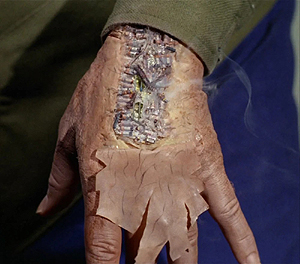
Kirk and Korby briefly struggled, and in the process Korby's skin was torn on his left hand, revealing wires and circuits. Korby also was an android. He insisted that he was still the real Roger Korby. But he could not demonstrate his humanity, and he started to show that his programming was malfunctioning. Kirk told him that his plans could not succeed. The attempt to program away human frailties and corruption to create a utopian society could not work, as evidenced in the breakdown of this smaller version of it. Especially the ability to kill with no more concern than turning off a light. Realizing the truth of his words, Korby handed his phaser gun to Kirk. But Andrea would not relinquish hers. She went to Korby to express her "love" for him, and as she embraced him, Korby pressed the trigger on her phaser gun and vaporized them both. Spock and his security team arrived moments later and asked about Korby's whereabouts. Kirk replied that he was never there. Efforts to create the kind of utopian society envisioned by Roger Korby in the Star Trek episode are not limited to the realm of science fiction but can be seen in the present time through the work of technocrats such as Elon Musk, who has expressed his goal to help human beings merge with artificial intelligence (AI) and the technologies facilitating it to enhance the cognitive and physical abilities of everyone and end disease, aging, and death. This effort by Musk is inspired by his transhumanist worldview, a belief system that calls for the use of science and technology to dramatically enhance human capabilities and direct long-term human development, often summarized by its adherents as the three "supers": superintelligence, superlongevity, and superhappiness (ways of achieving lasting happiness and satisfaction). Musk's Neuralink, a neurotechnology company founded in 2016, is at the forefront of developing brain microchips to restore mobility to those suffering from spinal cord injuries and sight to the visually impaired. In a subtle reference to the miracles of Jesus, he aims to help the lame to walk and the blind to see (Luke 7:18-23). Another of Musk's companies, Tesla, Inc., has transitioned its vehicle assembly factory in Fremont, California, to the mass production of humanoid robots beginning in July 2026. In an interview at the 2026 World Economic Forum (WEF) Annual Meeting, Musk was very positive that the marriage of AI with robotics would lead to unprecedented prosperity, satisfaction, and happiness for humanity. Some transhumanists of great wealth like Musk believe in developing technologies to digitize the mind so that it can be uploaded to another medium, such as a computer, robot, or cloud system. "Scan and copy" is considered by some of them to be a promising technique, where a brain would be scanned in detail to gather the information needed to produce a working copy of the brain, which could be uploaded to a computer in order to live forever. Like Roger Korby in the Star Trek episode, the transhumanists developing technologies to live forever believe that any undesirable traits or tendencies can be programmed away to create a utopian society. But they fail to take into account the innate corruption of man due to sin brought into the world through Adam's disobedience to God (Romans 5:12-21). Because of this, their efforts to create a perfect society cannot succeed, and their belief in eternal life apart from God is a lie. No matter how sophisticated they sound or their glowing promises, transhumanists offer only a poor copy of the resurrection life Jesus graciously gives to anyone who trusts in Him. Jesus said that one must be born again of the Spirit to enter the kingdom of God and that anyone believing in Him experiences this new birth and is gifted with eternal life (John 3:3-21, 36). He is the way, the truth, and the life (John 14:6), and He has proven this by His bloody death on the cross to pay for our sins, His burial, and His bodily resurrection from the dead three days later (1 Corinthians 15:1-4). Anyone who repents and believes in the Lord Jesus for the forgiveness of their sins will be reconciled to God, given a new nature and, when He returns, a new perfect, incorruptible body that will never perish. They will enjoy forever the utopia of God: His presence in the new heaven and new earth where infirmity, sorrow, pain, and death are permanently banished (Revelation 21:1-6).
What Elon Musk and other wealthy transhumanists offer is pyrite. Jesus Christ, on the other hand, offers gold. Believe in Him today! The real thing Jesus grants through faith in Him alone is far better than any counterfeit! |
|
 |
|
| What Is the Gospel? | What Must I Do to Be Saved? | Home | Contact Us | Return | |